APEX CONNECT by AIM — India's First & #1 Bulk Calling & AI Receptionist System
India's first and number one commercial bulk calling, bulk AI receptionist, and AI appointment system. Designed for all business categories including AI marketing near me, business marketing PR near me, digital marketing near me, social media marketing near me, HMS CRM near me, and ERP systems near me in all cities. Speaks English and Hindi, responding in under two seconds.
Our Core Services
Complete calling, messaging, and automation tools designed to connect you with clients globally.
Voice Broadcasting Service
Send bulk pre-recorded voice updates in seconds. Automated high-volume message delivery.
Outbound IVR
Multi-level interactive menus for confirmation and survey workflows. Smart IVR routing technology.
Bulk SMS Service
Broadcast high-speed promotional and transactional texts to large customer cohorts simultaneously.
Developer API
Connect CRMs, portals, and custom platforms with our API. Programmatic integration endpoints.
Transactional Messaging
Deliver automated OTPs, receipts, and order confirmation updates in real time.
Promotional Messaging
Launch discount campaigns and event notifications to drive conversions and client loyalty.
Voice SMS
Send direct audio files to add a personal, spoken touch. Combine the speed of text with voice.
Press 1 Campaigns
Guide callers to press 1 to reach agents or request callbacks. Interactive outbound caller flows.
VOIP Integration
Telephony configuration mapping to cut call overhead. Modern high-definition enterprise voice protocols.
Bulk WhatsApp
Dynamic templates, attachments, and messaging workflows on the official WhatsApp Business API.
Automated Outbound Dialer
Maximize talk-time and automatically dial leads. Boost agent productivity and outbound volumes.
SIP Trunking
Connect standard IP-PBX systems directly to global carriers. Reliable, high-capacity IP pathways.
See the platform in action
A quick walkthrough of the console your team — or your clients — log into every day.
One dashboard for every business
Calls, answer rate, capacity, and spend across all your businesses — live, in one view.
Open in app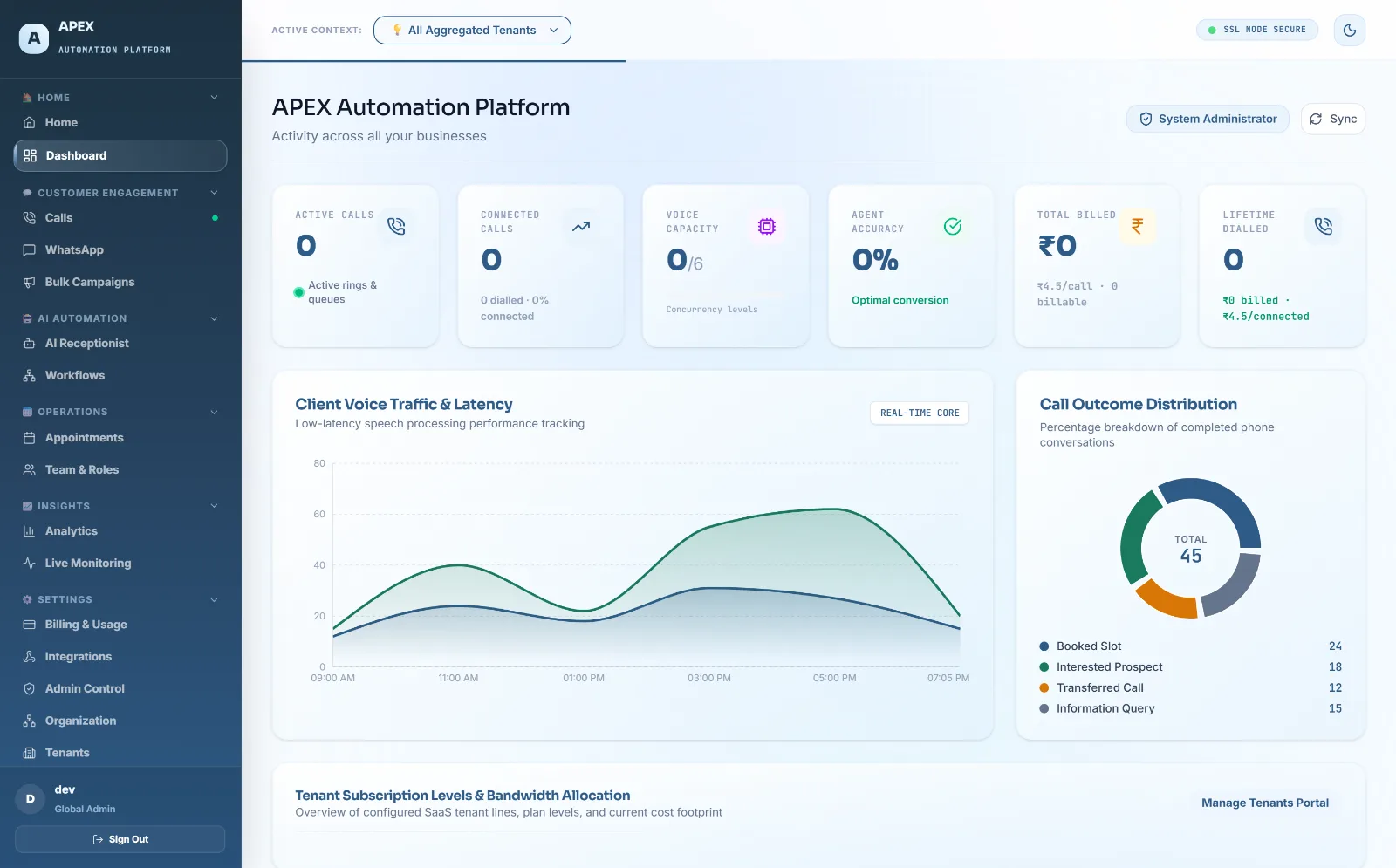
Watch every call as it happens
Inbound and outbound AI calls in real time, with a built-in dialer and instant human handoff.
Open in app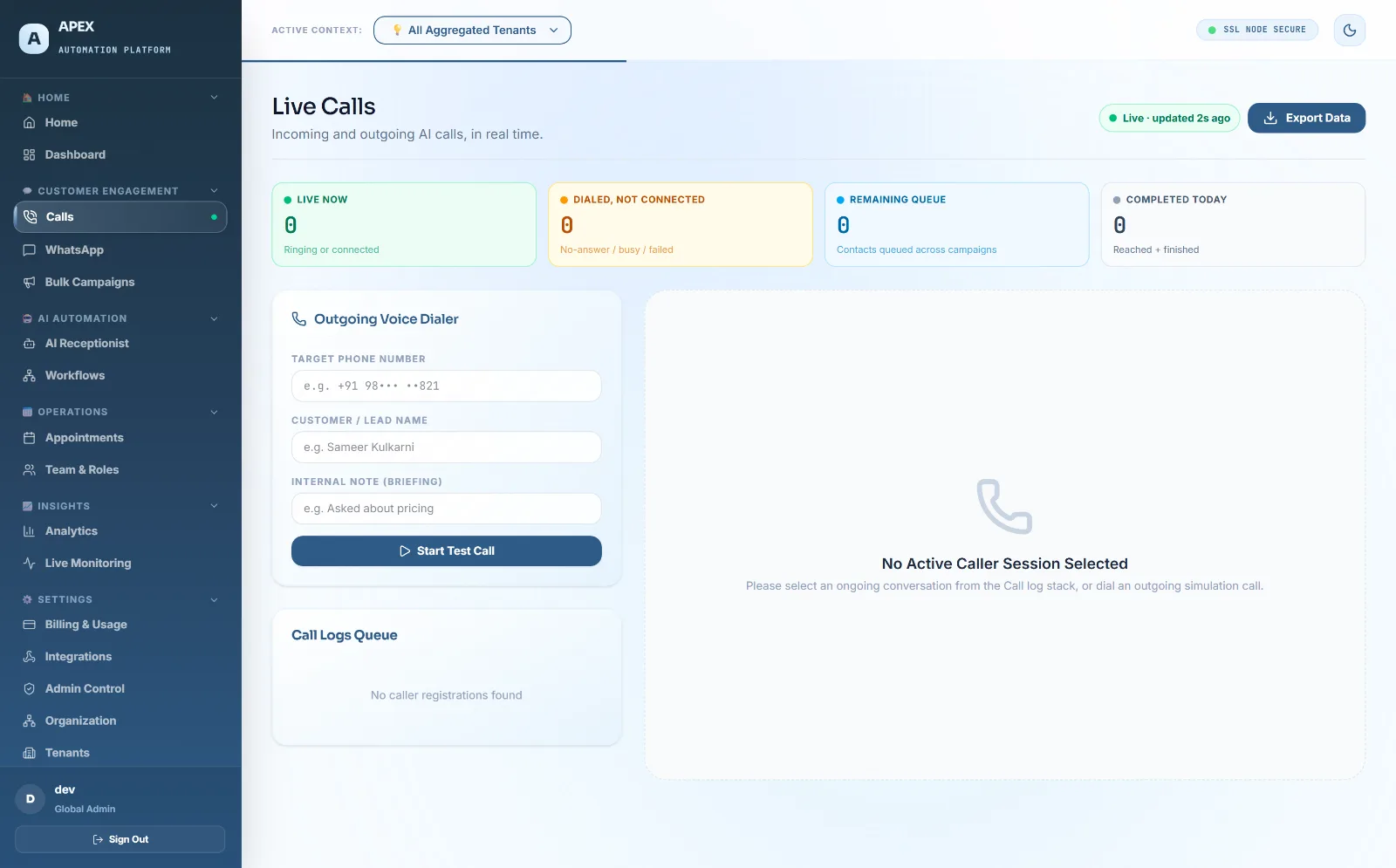
Automate the channel customers love
Auto-reply, capture leads, and confirm bookings on WhatsApp — answered by your AI assistant.
Open in app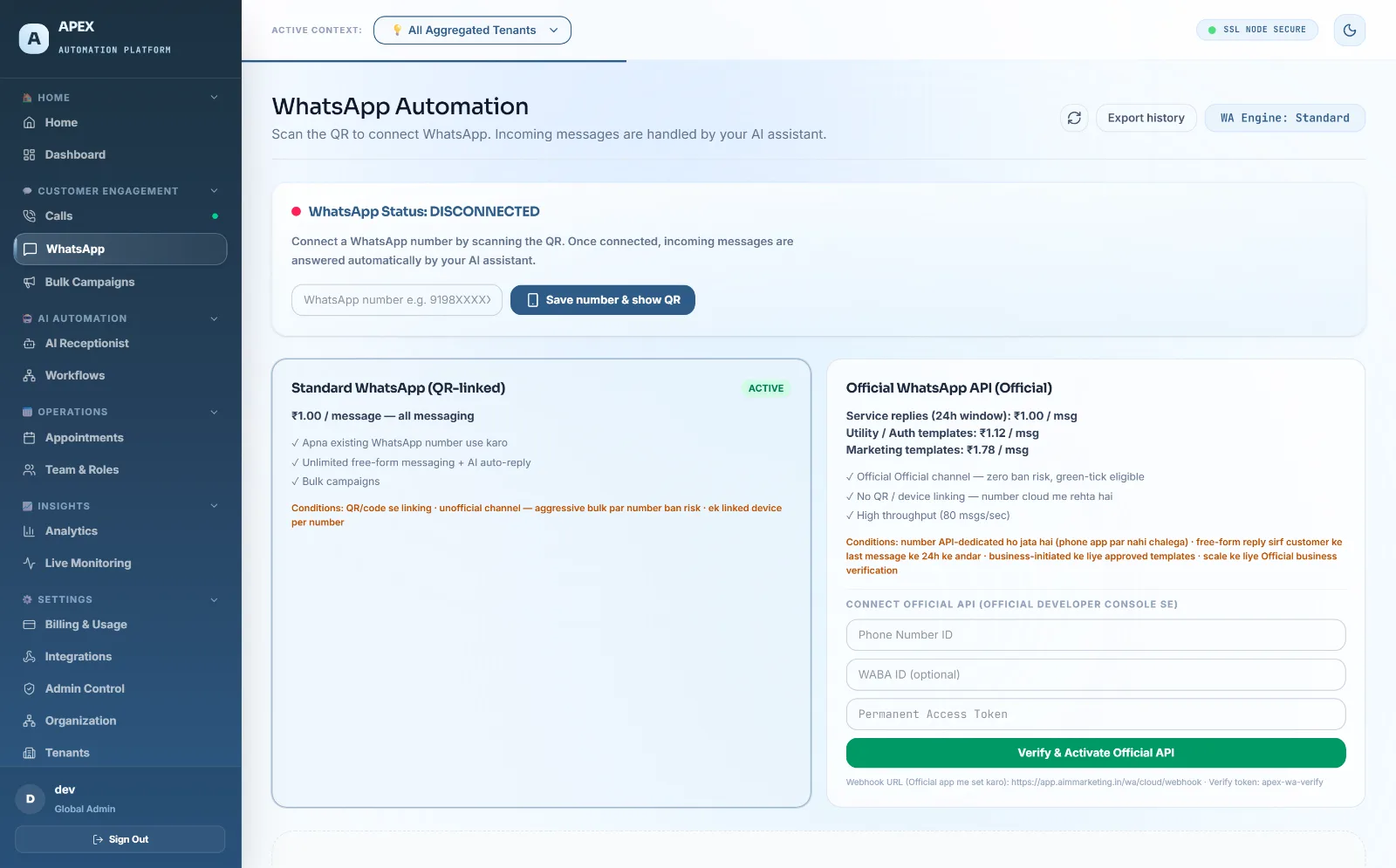
Launch calling campaigns in minutes
A guided wizard for high-volume AI voice and message flows — scripts, contacts, and pacing.
Open in app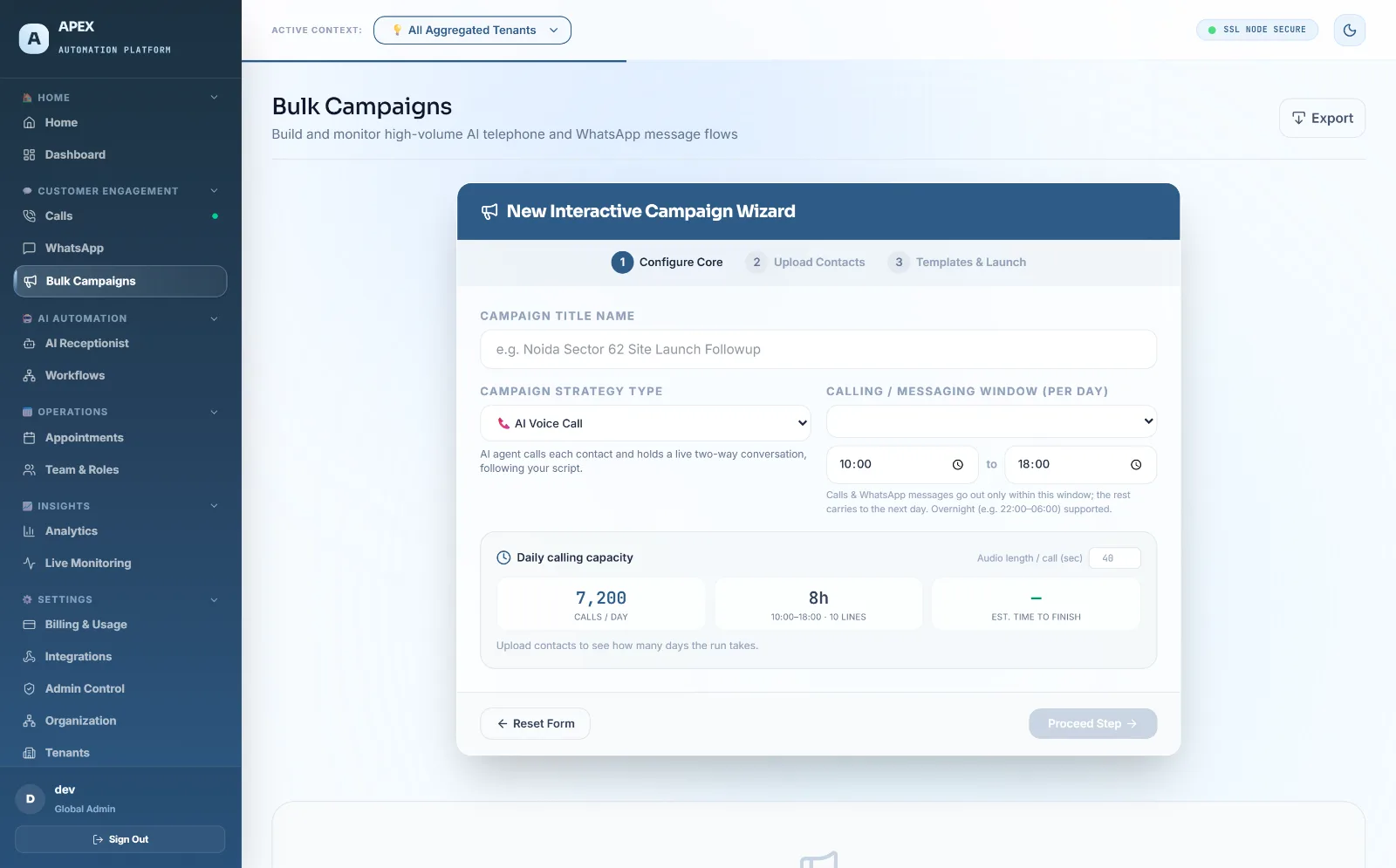
The assistant books appointments for you
Books, reschedules, and logs every appointment from the call — synced to your calendar.
Open in app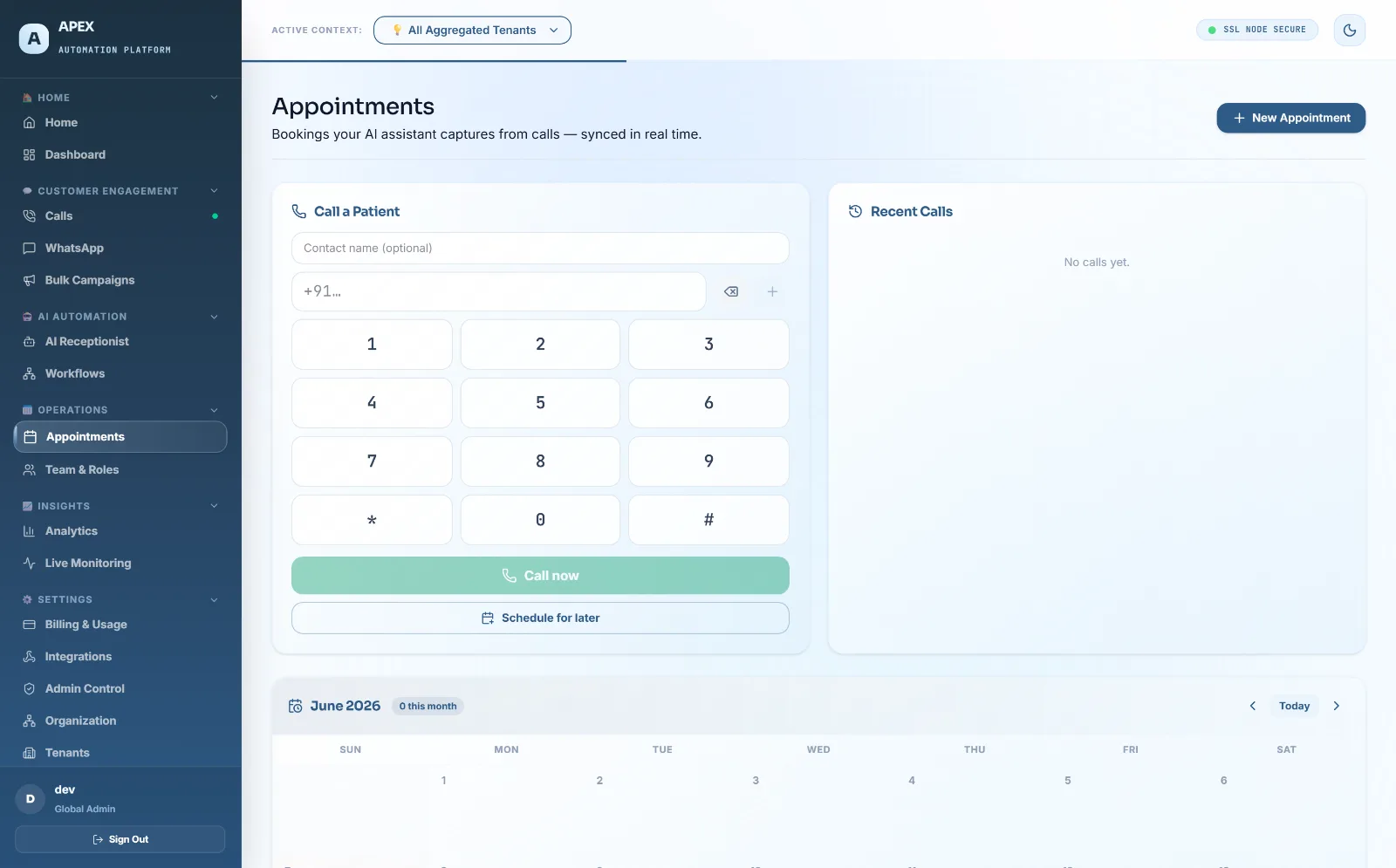
Build automations by dragging blocks
Triggers, AI agents, and actions snap together into workflows — no developer required.
Open in app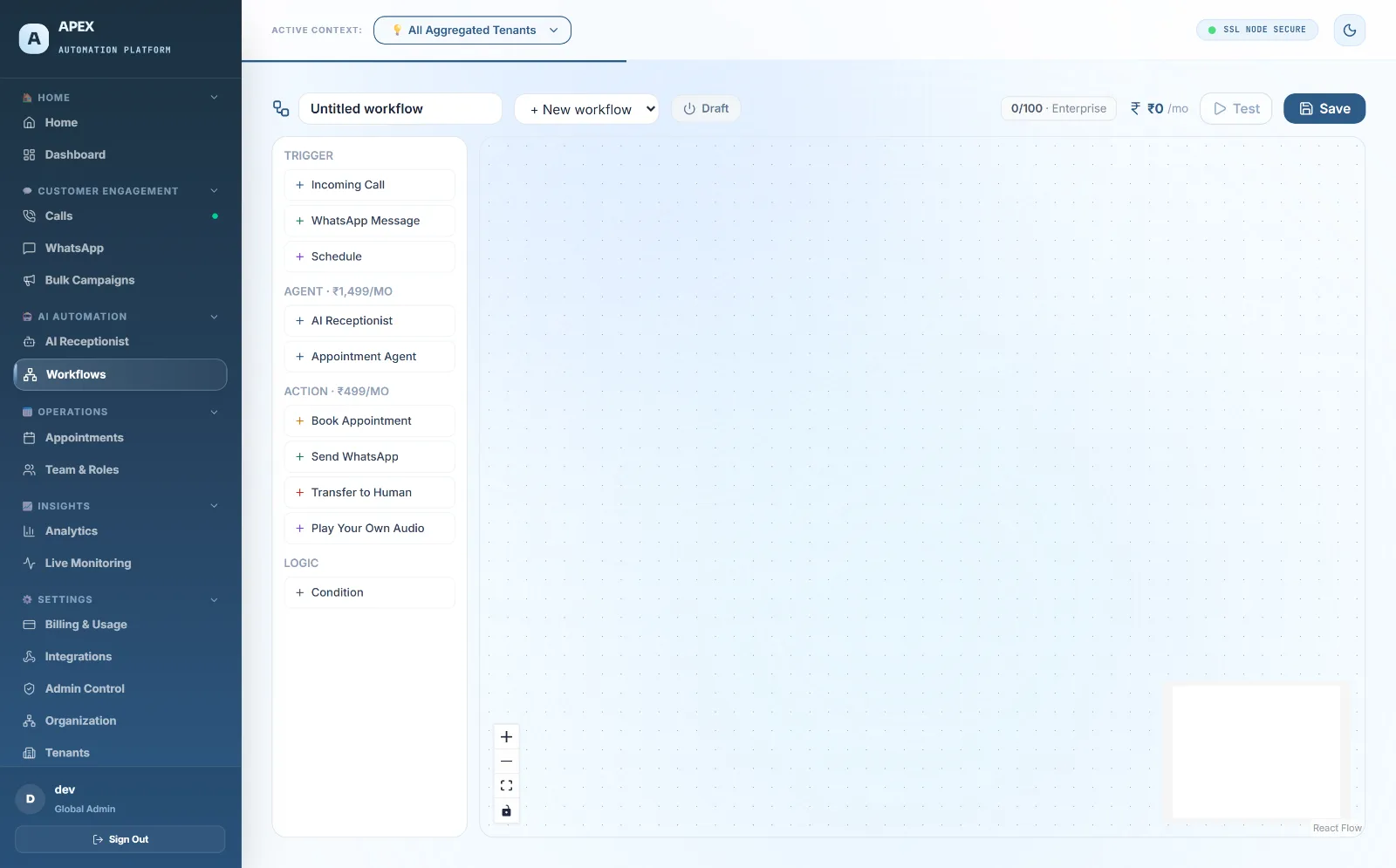
See exactly what every call costs
A live cost room with per-call rates, spend, and revenue — full transparency, no surprises.
Open in app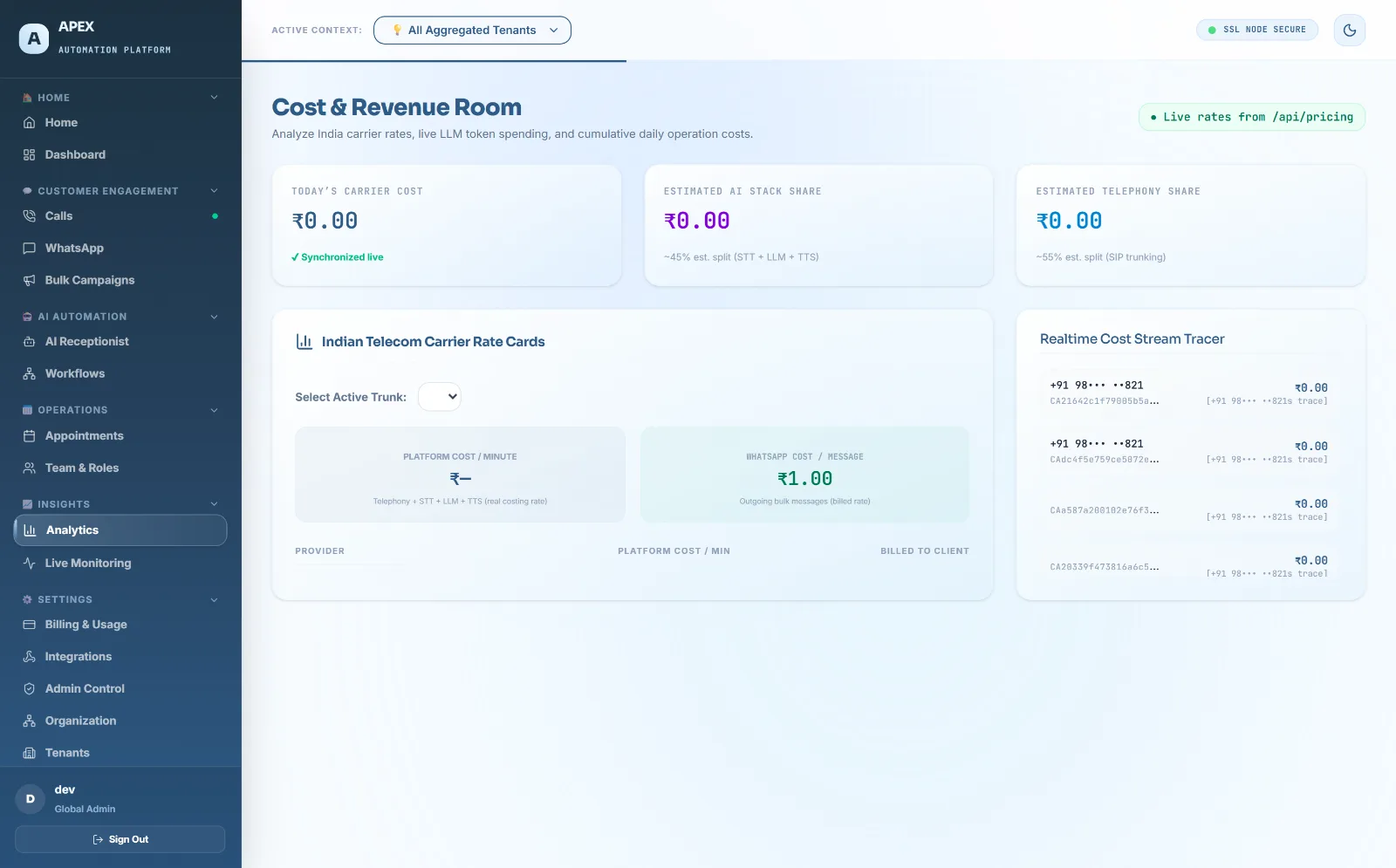
Run many businesses from one panel
Separate workspaces with their own plan, limits, and budgets — switch in a click.
Open in app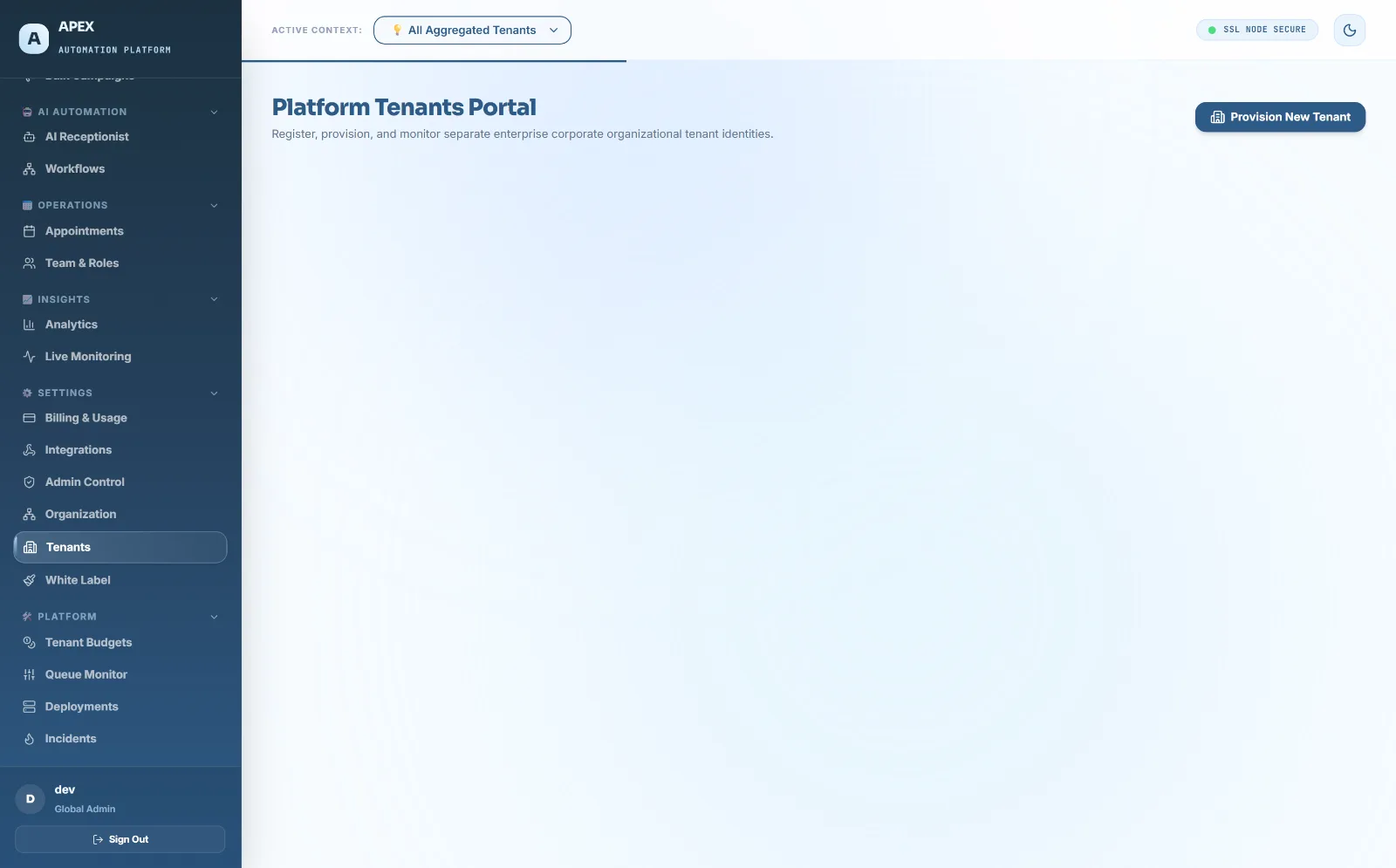
Make it yours — or your clients’
Your brand, your domain, your pricing. License the whole platform under your own name.
See licensing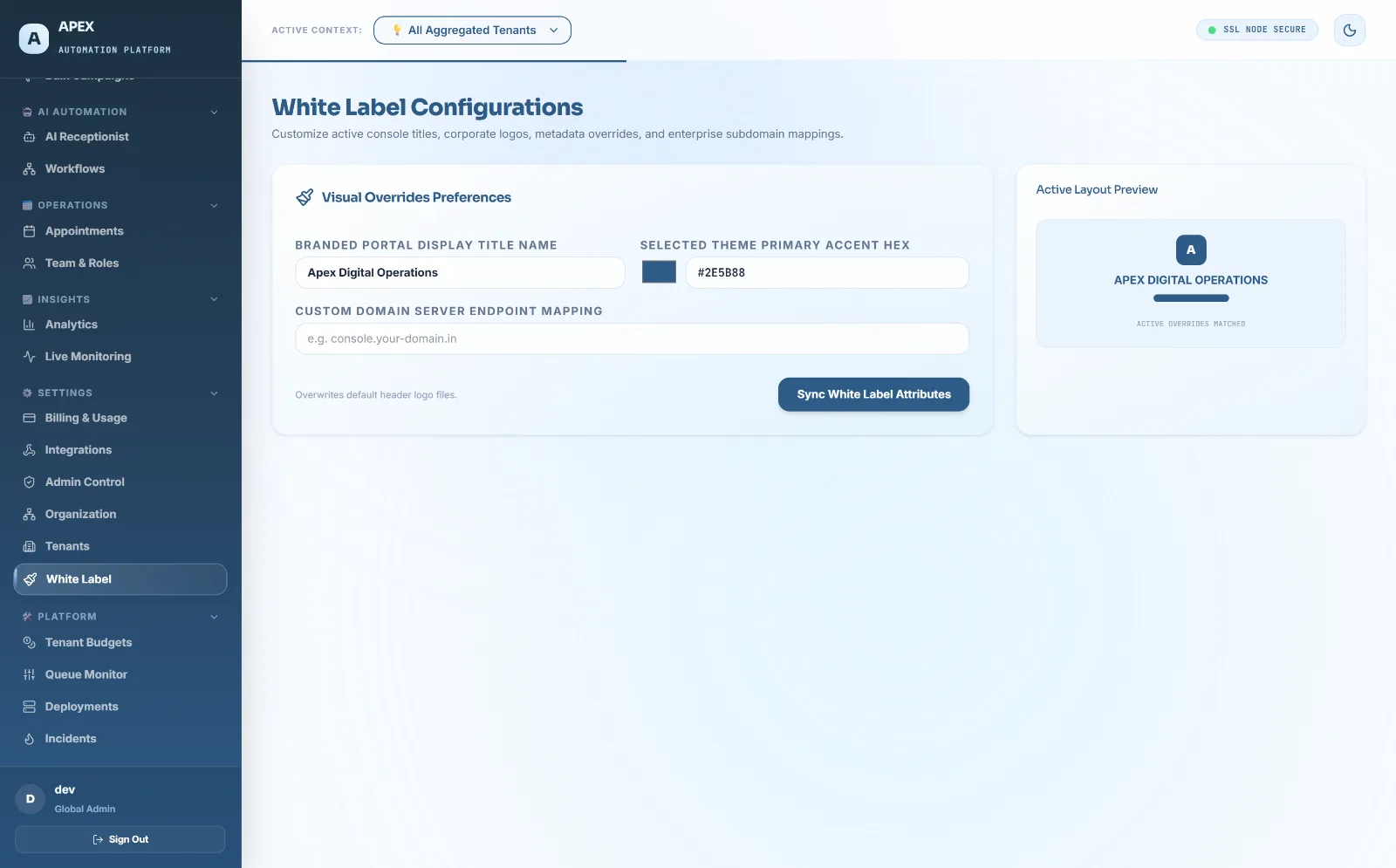
Built for every stage
From a single solo line to an enterprise rollout — and agencies who license it as their own.
Self-serve plans
Pick a plan, launch in minutes, and let AI answer every call and message. Activates instantly from your dashboard.
View plansTalk to us
Multiple numbers, teams, and locations? We tailor a plan to your call volume and set you up end to end.
Contact salesWhite-label licensing
Run the whole platform under your own brand and domain, multi-tenant, with SLAs and custom integrations.
Contact salesBuilt by an AI Systems Engineer
APEX CONNECT answers the calls and books the appointments. A REST API, a Go SDK, the apex CLI and an MCP server give your own systems the same access.
Everything You Need
AI Receptionist
Outbound Calling
WhatsApp Automation
White-Label Licensing
Live System Results
Real performance from our AI automation systems in businesses
How It Works
Customer submits number
Lead enters their contact information
AI calls instantly
Our system dials immediately
Books appointment or collects info
Intelligent conversation handles the rest
APEX CONNECT
AI voice agents, bulk calling and WhatsApp automation — with a REST API, SDK, CLI and MCP server behind them.
Questions, answered
What is APEX CONNECT by AIM?
APEX CONNECT by AIM is an AI voice platform for business. It answers every inbound call as a 24/7 AI receptionist, runs automated outbound calling campaigns, books appointments on the call, and handles WhatsApp messages — for one business, or white-label and multi-tenant for agencies.
What can the AI receptionist do?
It answers calls 24/7, understands the caller, books or reschedules appointments, captures leads, answers FAQs, and hands off to a human when needed — in English and Hindi.
Can I run APEX CONNECT under my own brand?
Yes. APEX CONNECT is multi-tenant and white-label: agencies and resellers run the whole platform under their own brand, domain and pricing, managing many clients from one dashboard.
Which regions does APEX CONNECT serve?
Businesses across India, the United Kingdom and the European Union — with data-protection alignment for GDPR (UK/EU) and India's DPDP Act.
How fast does the AI respond on a call?
Typically under two seconds per turn, so conversations feel natural and real-time.
How much does APEX CONNECT cost?
APEX CONNECT offers self-serve plans starting from affordable tiers for solopreneurs, scaling to enterprise white-label licensing. Visit the pricing page for current plans or contact sales for custom enterprise quotes.
What languages does APEX CONNECT support?
APEX CONNECT currently supports English and Hindi for both inbound and outbound voice calls, with Devanagari sentence boundary detection for natural Hindi TTS streaming.
How do I integrate APEX CONNECT with my existing systems?
APEX CONNECT integrates via API with popular CRMs, calendaring tools, and communication platforms. The platform connects with Twilio for telephony, WhatsApp Business API for messaging, and supports webhook-based integrations with any system.
Is APEX CONNECT secure and GDPR compliant?
Yes. APEX CONNECT is built with data-protection alignment for GDPR (UK/EU) and India's DPDP Act. Call recordings and data are encrypted, and the multi-tenant architecture provides per-tenant data isolation.
How long does it take to set up APEX CONNECT?
Self-serve plans activate instantly from the dashboard — you can be live in minutes. Enterprise and white-label deployments typically take 1–2 weeks including custom configuration and onboarding.
Does APEX CONNECT support human handoff during calls?
Yes. APEX CONNECT can seamlessly transfer a live call to a human team member when the AI detects the caller needs specialised help, ensuring no customer is ever stuck in an AI-only loop.
What technology stack does APEX CONNECT use?
APEX CONNECT is built on enterprise-grade cloud infrastructure integrated with state-of-the-art conversational AI models and high-speed voice streaming protocols. This ensures sub-second response times, secure multi-tenant data isolation, and natural, real-time conversation flows.
Put your calls on autopilot
Drop your details — we'll reach out within 24 hours.